
I. The Rise of Small-Batch Folding Cartons: Market Dynamics and Challenges
The folding carton market has historically been dominated by high-volume production, where the goal was to minimize the cost per unit through massive scale. Today, the landscape looks remarkably different. Trends such as “limited edition” packaging, regionalized marketing, and the explosion of e-commerce startups have turned “small-batch” from a niche request into a mainstream necessity. To meet these needs, a China Leading Manufacturer of Flatbed Knife Cutting Machine for Folding Cartons, such as Hangzhou IECHO Science & Technology Co., Ltd. (IECHO), has pioneered technologies that bridge the gap between artisanal quality and industrial efficiency. By integrating intelligent cutting systems into the production line, manufacturers are no longer forced to choose between high costs and lost opportunities.
When we talk about small-batch production, we are usually referring to runs ranging from a single prototype to a few thousand units. In this scenario, the primary obstacle is not the material cost, but the “setup-to-run” ratio. If a technician spends three hours setting up a machine for a job that takes only thirty minutes to complete, the operational efficiency collapses. Furthermore, small-batch clients often demand faster turnaround times. They expect their packaging to be ready in days, not weeks.
For a packaging house, the investment in production tools must be weighed against these fluctuating demands. Traditional methods require significant upfront capital for dies, which are essentially “frozen” designs. If the client wants to change a flap size by 2mm, a new die must be forged. This is where the flexibility of modern technology becomes a competitive lifeline, allowing companies to pivot without the burden of physical mold limitations.
II. Traditional Die-Cutting: The Powerhouse of Mass Production
Conventional die-cutting relies on a physical template—a die—made of wood and steel blades to punch out shapes from cardstock or corrugated board. It is a mechanical process built for speed and repetition.
The Characteristics of Die-Cutting
The process involves a heavy-duty press that applies tons of pressure to force the die through the substrate. For large-scale orders of 50,000 units or more, the speed of a die-cutter is unmatched. Once the machine is running, it can process sheets at an incredible rate.
The Advantages and Disadvantages
The primary advantage is the low unit cost at high volumes. However, the disadvantages become glaringly apparent in the small-batch context:
l High Tooling Costs: A custom die can cost hundreds or even thousands of dollars.
l Storage and Maintenance: Physical dies require warehouse space and regular sharpening.
l Inflexibility: Any design change renders the existing die obsolete.
l Lead Times: Waiting for a die shop to fabricate and ship a tool can add a week to the production schedule.
For businesses looking to innovate, IECHO has introduced systems focused on the rapid replacement of dies. While this enhances traditional die-cutting efficiency, it still operates within the paradigm of physical tooling. For many, the answer lies in moving away from physical blades entirely.
III. Flatbed Knife Cutting: The Digital Evolution for Flexibility
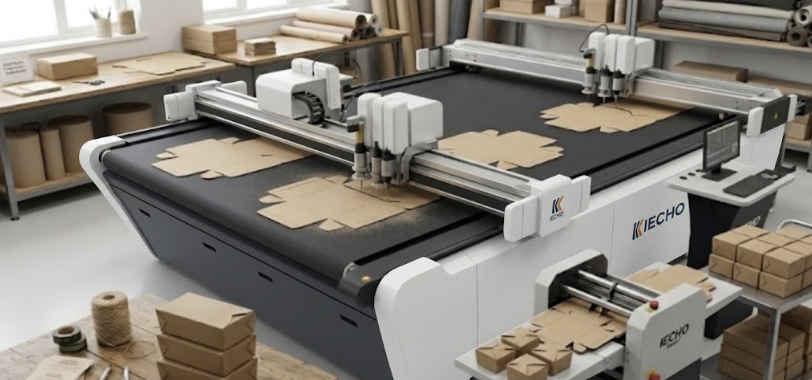
Flatbed knife cutting, often referred to as digital finishing, uses a computer-controlled cutting head equipped with various tools to follow a digital path. As a global intelligent cutting solution supplier, IECHO has refined this technology to serve more than 10 industries, including printing and packaging.
The Characteristics of Flatbed Systems
Unlike die-cutting, there is no physical “mold.” The design is sent directly from a CAD file to the machine. Systems like the IECHO BK4 high speed digital cutting system utilize a multi-tool head that can switch between cutting, creasing, and marking in a single pass. This versatility is essential for folding cartons, which require precise creases to ensure the box folds perfectly without cracking the printed surface.
The Comparative Advantages for Small Batches
l Zero Tooling Cost: Since the “die” is a digital file, the cost of starting a new job is effectively zero. This makes short-run jobs commercially viable.
l Instant Prototyping: You can cut the first sample, check the fit of the product, and start the full run immediately.
l Precision and Quality: The BK4 system offers high-speed and precise cutting, ensuring that even complex geometric designs are executed with high accuracy.
l Material Savings: Advanced nesting software optimizes the layout of cartons on a sheet, reducing waste in a way that is difficult to achieve with fixed physical dies.
IV. Navigating the Cost-Benefit Analysis: A Direct Comparison
When choosing between these two solutions, the decision usually hinges on the “Break-even Point.” For high-volume production, traditional die-cutting remains the dominant force due to its sheer mechanical speed. However, once the volume drops below a few thousand units, the economic logic shifts dramatically toward flatbed knife cutting.
The most significant differentiator is the initial setup cost. In a traditional setup, the cost of the die must be amortized over the entire run. On a 100,000-unit job, a 500-dollar die adds only half a cent to each box. On a 500-unit job, that same die adds a full dollar to the cost of every single carton, often pricing the manufacturer out of the market. Flatbed systems eliminate this financial barrier entirely, maintaining a consistent cost-per-unit regardless of the batch size.
Furthermore, the setup time creates a massive divide in operational agility. Conventional die-cutting requires one to three hours for calibration and mounting, whereas a digital flatbed system like the BK4 can be ready to cut in under ten minutes. This allows for a “Just-in-Time” (JIT) delivery model. While die-cutting is restricted by the lead time of tool fabrication—often taking several days—the digital approach allows a packaging house to go from design to finished product in a single afternoon.
V. Technological Innovation as a Growth Driver
The transition to digital flatbed cutting is not just about removing the die; it is about intelligent automation. Hangzhou IECHO Science & Technology Co., Ltd. has invested heavily in R&D, with over 30% of its 400-plus employees dedicated to innovation. This focus has resulted in machines that are not just cutters, but smart workstations.
For example, the BK4 Large Format Cutting System is designed for 24/7 operation in demanding industrial environments. It provides a professional solution for the non-metal industry, allowing enterprises to undergo a digital transformation. With a manufacturing base exceeding 60,000 square meters, IECHO ensures that every machine meets rigorous quality management standards, including ISO certifications for environment and occupational health.
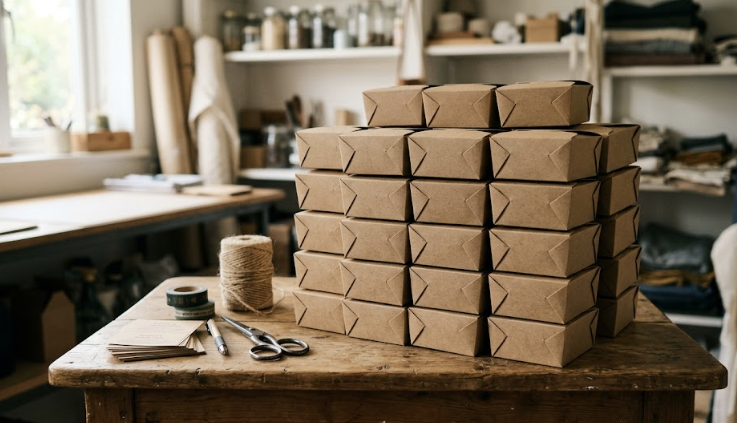
In a practical scenario, consider a packaging manufacturer in an international trade hub. By using an IECHO system, they can receive a digital file from a client in the morning and have a finished batch of 1,000 folding cartons ready for shipping by the afternoon. This level of responsiveness is what defines a market leader in the modern era.
VI. Conclusion: Making the Strategic Choice
Choosing the “best” solution depends entirely on your business model. If your facility produces millions of identical cereal boxes, traditional die-cutting remains the king of throughput. However, if your growth strategy involves high-margin, short-run, or customized folding cartons, the flatbed knife cutting machine is the superior investment.
IECHO continues to redefine intelligent cutting technology, helping users in over 100 countries create value through precision and efficiency. By prioritizing high-quality service and customer-led innovation, they provide the tools necessary for the packaging industry to thrive in an increasingly fragmented and fast-paced market.
For more information on intelligent cutting solutions and the full range of IECHO products, please visit: https://www.iechocutter.com/