
In the production of roll self-adhesive labels, web stretching and edge deviation are widespread, longstanding issues troubling print enterprises. Paper and film rolls are highly prone to lateral and longitudinal stretching deformation after heating and drying on digital printing presses. Traditional die-cutting equipment is only equipped with basic single-edge photo-electric edge guiding, which can only correct unilateral shifts and fails to compensate for cumulative web stretch. This causes misregistration between the diecut contours and printed graphics, resulting in frequent batch rejects. Many printing companies report that the scrap rate per batch of processed rolls can reach 5% to 10%, causing tens of thousands of yuan in annual raw material losses that directly erode order profits. Addressing this industry pain point in roll registration accuracy, the entire IECHO LCT laser die-cutter series is equipped with a triple-linkage precision control system featuring ultrasonic intelligent edge guiding, magnetic powder constant tension control, and photoelectric sensor automatic positioning. It corrects web deviation comprehensively, maintaining a stable die-cutting precision within±1 mm and significantly reducing material scrap losses.

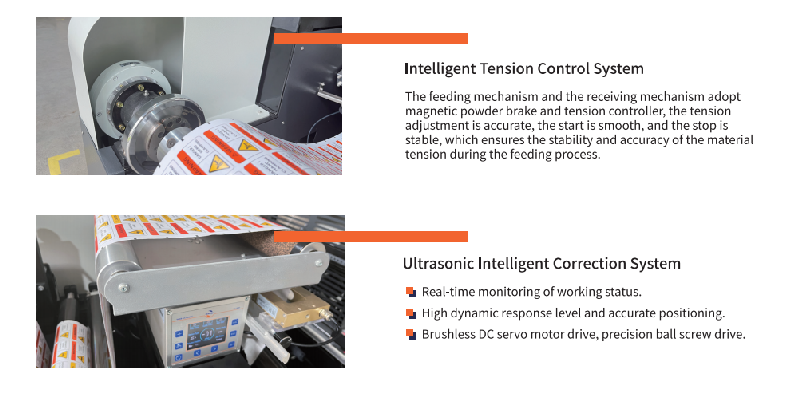
The triple precision system features distinct responsibilities working in a synchronized, closed-loop correction architecture. The first layer is the ultrasonic intelligent servo edge guiding system. Unlike traditional single-sided photo-eye web guides, the ultrasonic sensor does not rely on printed color marks, allowing it to detect transparent PET, PP films, and matte labels without background colors stably. It captures left and right web shifts in real time, while a brushless DC servo motor paired with a precision ball screw quickly adjusts the web position. With fast dynamic response speeds, it continuously corrects deviation even at high web speeds, preventing cumulative misregistration caused by continuous drift.
The second layer is the intelligent magnetic powder tension control system. Both feeding and rewinding ends are equipped with magnetic powder brakes and dedicated tension controllers to precisely regulate web tightness. Tension remains smooth and balanced throughout equipment startup, high-speed operation, and stopping, preventing problems like front-end material stretching or back-end web slack and wrinkling. For easily stretched thin films like thin PET and BOPP, constant tension effectively suppresses material elongation deformation, resolving misregistration between printed patterns and die-cutting lines at the root. Rigid rolls such as thick coated paper and metallic paper also maintain smooth web travel without warping or wrinkling, guaranteeing uniform die-cutting alignment.
The third layer is the photoelectric sensor automatic positioning system. Photoelectric components are linked with the laser processing system in real time, automatically identifying registration marks on the printed web upon machine startup. The control system automatically calculates the die-cutting baseline according to the mark coordinates, dynamically matching web speed with the laser cutting path to accurately compensate for slight stretch errors generated after printing. Even if stretching varies between the front and rear sections of a roll, the equipment dynamically adjusts the laser cutting path to ensure every single label pattern perfectly coincides with the cut line, completely solving industry headaches like large manual alignment errors and batch registration scrap.
This complete precision system is compatible across all LCT series models, maintaining fully standardized hardware specs between the new compact LCT2 and the first-generation mass-production LCT350. Whether processing small-batch short rolls in local shops or ultra-long continuous rolls in industrial plants, the correction system maintains stable performance. In actual testing with challenging substrates, such as 45μm ultra-thin PET adhesives, 280g thick coated paper, and brushed silver metallic paper, the scrap rate per thousand labels was controlled within 1%, reducing material loss by 70% compared to traditional die-cutting equipment.
In addition to precision hardware, the onboard fly-cutting control system further supports finished product consistency. With linear laser cutting speeds up to 8 m/s, the material moves continuously without stopping or decelerating, avoiding tension fluctuations and position shifts caused by frequent starting and stopping. The heavy-duty welded steel chassis provides high rigidity with minimal structural vibration during high-speed operation, further ensuring long-term processing accuracy and stability.
For label enterprises that rely on roll-fed self-adhesive processing for profitability, raw material loss represents a major cost expenditure that cannot be ignored. The IECHO LCT Series triple-coordinated precision control system manages processing deviations across three dimensions: web position, material tension, and pattern alignment. By effectively lowering scrap rates and saving raw material expenses, long-term operation creates substantial cost savings, making it an essential equipment solution for solving roll registration loss challenges.