
Over the past ten years, the global advertising, graphic arts, and packaging industries have experienced a massive transformation from manual operation to digital intelligent manufacturing. However, store-level intelligent processing equipment has consistently been trapped in a dilemma: “small models lack performance, while large models carry high costs.”
Industry Dilemma: The “Impossible Trinity” of Store-Level Intelligent Processing
According to industry survey data released by the Global Printing and Packaging Industrial Association, 85% of advertising, graphic arts, and packaging processing storefronts worldwide are small-to-medium-sized operations. These businesses typically operate within a floor plan of under 100 square meters and maintain a budget for a single machine between $10,000 and $30,000. For a long time, the intelligent cutting equipment industry has been plagued by an unsolved “Impossible Trinity”: the inability to simultaneously achieve a compact footprint, high performance, and an affordable price point.
To control costs and volume, traditional small equipment generally adopts simplified body structures and low-end core components. This leads to major setbacks, including high vibrations during high-speed operations, rapid loss of cutting precision and an inability to process thick materials. After just 1 to 2 years of use, these machines suffer from a drop in cutting accuracy and frequent breakdowns. On the other hand, while industrial-grade large equipment offers stable performance, it typically requires a footprint of over 6 square meters and costs upwards of $50,000—a financial burden that the vast majority of small-and-medium stores simply cannot bear. This dilemma has left more than 60% of small-and-medium shops worldwide relying on manual or semi-manual processing methods. The resulting low production efficiency and unstable quality have severely bottlenecked the industry’s digital transformation.
Through more than a decade of technical iterations and global market validation, the IECHO PK Series has built three core technology systems, successfully striking a perfect balance between a compact frame, stable performance, and high cost-effectiveness.
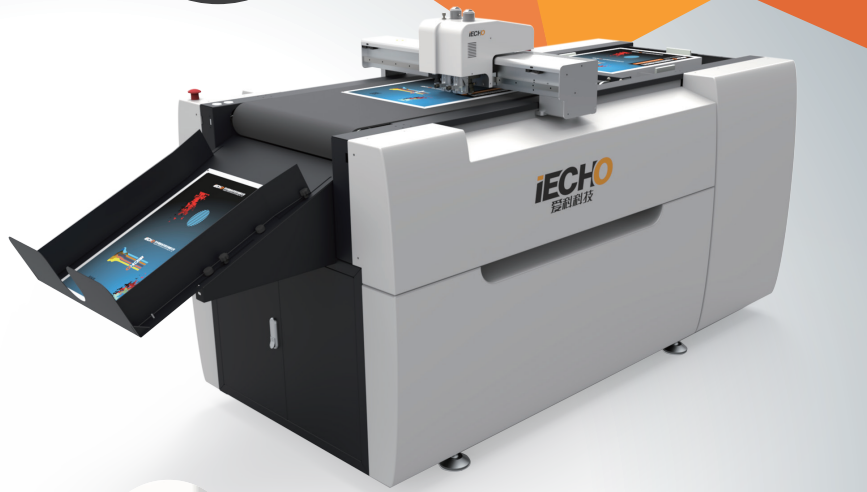
The first core technology is the Compact, High-Rigidity Body Technology. Through structural mechanics simulation and optimization, IECHO R&D team completely re-engineered the stress structure and material distribution of the machine frame. By utilizing a one-piece cast steel structural base paired with a high-strength aluminum alloy gantry, the machine’s footprint was compressed to just 60% of industrial equipment in its class, while achieving a rigidity-to-weight ratio that far exceeds the industry average. Even when operating at high speeds of up to 1,500 mm/s, the body’s vibration amplitude is controlled to an industry-leading standard. This physical architecture structurally guarantees the equipment’s long-term operational precision and stability over an 8-to-10-year lifespan. Furthermore, with its fully integrated, ex-factory design, all debugging and precision calibration are completed prior to shipping. The machine requires only simple on-site commissioning to go into production, perfectly adapting to the demands of global cross-regional transportation and installation.
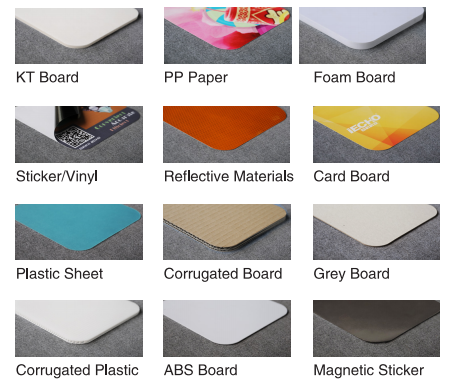
The second core technology is the Universal Tool Intelligent Matching and Cutting Technology. To address the industry pain points of scattered material categories and complex parameter debugging, the IECHO R&D team collected processing data from tens of thousands of storefronts worldwide to construct a standardized process parameter library covering dozens of universal materials. Equipped with a closed-loop controlled, high-frequency vibration unit, the system automatically matches the vibration frequency, cutting speed, and tool angle based on the material’s hardness, thickness, and density. It delivers adaptive parameter matching for everything from ultra-thin 0.1 mm films to thick 16 mm boards. This eliminates the need for operators to repeatedly debug complex parameters manually, enabling even beginners to output high-quality finished products consistently.
The third core technology is the CCD Vision Distortion-Compensation Registration Cutting Technology. Addressing the critical issue of registration cutting waste caused by material stretching and deformation during post-press processing, IECHO developed an exclusive vision distortion-compensation algorithm. By recognizing multiple registration marks, the system calculates the material’s overall deformation matrix and automatically corrects the cutting path in real-time. Even if the material exhibits irregular stretching, tilting, or shifting, it can still achieve precise registration cutting within ±0.1 mm. This reduces material waste rates by over 90%, thoroughly solving a registration loss challenge that has troubled the industry for decades.
Ushering in the Era of Ubiquitous Store-Level Intelligent Processing
The mature application of these three core technologies allows small-and-medium storefronts to enjoy industrial-grade processing performance and stability without bearing the exorbitant costs and space requirements of traditional industrial-grade machinery. To date, cumulative global sales of the IECHO PK Series have exceeded tens of thousands of units, spanning dozens of countries and regions. By becoming the standard production configuration for tens of thousands of shops worldwide, it has truly ushered in the era of ubiquitous store-level intelligent processing.