
In recent years, the adoption rate of digital roll-fed printing equipment has continued to rise, with digital presses breaking through material feed speeds. After introducing high-speed digital printing lines, many print factories discover that downstream die-cutting processing speeds cannot keep up with printing output. Printed rolls pile up in large quantities, turning the die-cutting process into a capacity bottleneck for the entire production line. Factories are forced to add extra labor or purchase additional equipment to distribute processing pressure, further inflating production costs. Traditional mechanical die-cutting requires stopping, waiting, and segmented processing, resulting in a low speed ceiling that fails to match the continuous output pace of high-speed digital printing. Meanwhile, low-end laser die-cutters feature limited laser power and slow motion control responses, leading to uncontrollable registration accuracy under high-speed feeding, making them unsuitable for large-scale mass production. Equipped with mature high-speed fly-cutting technology, the IECHO LCT Series achieves instantaneous laser cutting speeds of up to 8m/s and a stable overall machine output speed of 46 m/min. Materials are processed continuously without interruption, perfectly matching various high-speed digital printing lines and eliminating post-press capacity bottlenecks.

The core logic of fly-cutting is “continuous material feeding with dynamic laser tracking.” Unlike the segmented processing mode of traditional die-cutting machines, which relies on a feeding-stopping-cutting-re-feeding cycle, the LCT Series utilizes a closed-loop motion control system composed of servo motors and web encoders. It synchronizes material feed speed with laser cutting paths in real time. While the web moves forward at a constant speed, the laser spot dynamically tracks and cuts the material simultaneously without any pauses or waiting time. This maximizes machine processing hours and significantly increases output per unit of time. Official test data clearly demonstrates the machine’s capacity advantages: for standard 6 x 6 cm coated paper self-adhesive labels, a batch of 1,000 finished pieces takes only 36 seconds to complete the entire die-cutting process; for large-format 12cm x 9 cm PET self-adhesive labels, processing 1,000 pieces takes just 92 seconds. For equivalent batch sizes, processing efficiency is more than 3 times that of traditional rotary die-cutting equipment.
Laser hardware serves as the core support for high-speed, stable cutting. The entire series comes standard with a 300W metal RF laser delivering uniform, stable beam energy. Under high-speed dynamic cutting conditions, thin films will not suffer from incomplete cuts, and thick papers will not experience burnt or carbonized edges, maintaining consistent depth across both full-cut and kiss-cut processes. Paired with the Laser Box integrated optical path system, optimized optical structures reduce light loss and extend the service life of optical components by up to 50%. Its IP44 dustproof protection rating is built for long-term, high-intensity workshop mass production, preventing laser power attenuation and speed drops caused by dust accumulation, ensuring long-term high-speed performance without compromise.
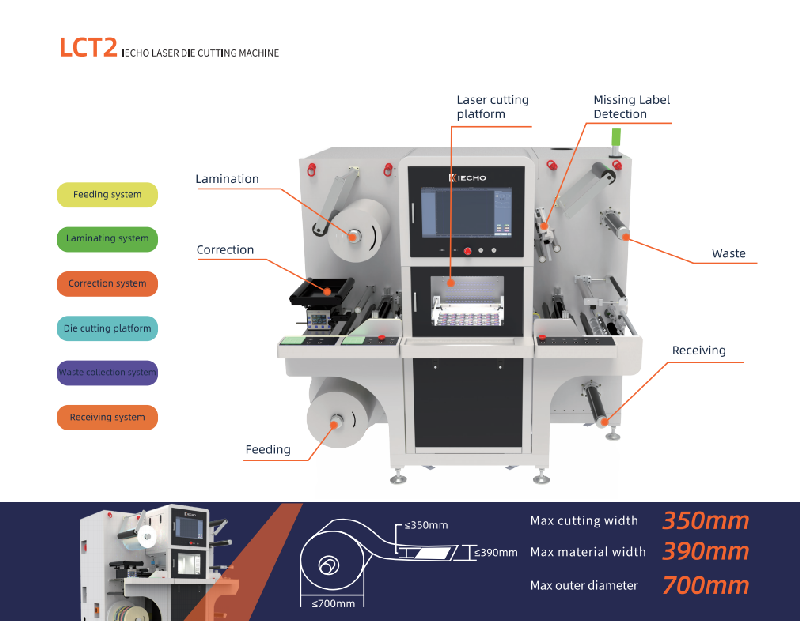
The overall mechanical structure safeguards high-speed processing. The main frame adopts an all-steel welded construction, precision-machined by a five-axis gantry milling machine and stress-relieved through anti-aging treatments. The body remains resonance-free and vibration-free during high-speed feeding at 46 m/min. Both feeding and rewinding mechanisms are integrally molded on CNC machine tools, providing flat roll installation baselines. Combined with magnetic powder constant tension control, the web experiences no stretching or wrinkling during high-speed transport, maintaining registration accuracy within a stable ± 1 mm during high-speed operation. The ultrasonic intelligent edge guide system responds dynamically and rapidly, correcting web deviation in real time during high-speed feeding to prevent misregistration scrap caused by speed increases.
The model adapts to diverse production scenarios. The new compact LCT2 model is suitable for small-to-medium print shops paired with small-to-medium digital presses, supporting both short-run proofing and daily mass production. The extended horizontal LCT350 model features dual independent rewinding shafts, allowing it to interface with high-speed industrial digital presses to handle ultra-long, continuous roll high-volume orders without frequent stops for roll changes. The equipment supports mainstream print file formats including AI, PDF, and DXF. Printed files can be imported directly to match fly-cutting paths without secondary file conversion, avoiding dimensional errors caused by format conversion and achieving seamless data connectivity between printing and die-cutting.
In today’s digital printing market, the core of competition lies in delivery speed and daily capacity; downstream die-cutting speed directly determines a factory’s daily order ceiling. IECHO LCT Series’ high-speed fly-cutting technology breaks through traditional die-cutting speed bottlenecks, perfectly matching the continuous production pace of digital printing. It helps print factories absorb more orders, shorten customer lead times, and enhance order-taking competitiveness in the market.